Why Your Underwear Makes You Hot at Work (And What to Do About It)
You're sitting at a desk, doing nothing strenuous — yet you're overheating. Your underwear is probably to blame. Here's the science and the fix.
The Office Heat Paradox
Here's something that doesn't quite make sense on the surface: you're sitting at a desk. You're not exercising. The office is air-conditioned. And yet, by mid-morning, there's a localized heat and discomfort situation developing in your underwear that only gets worse as the day progresses.
This isn't imagined. It has a specific physiological explanation — and a specific set of solutions. Understanding why it happens is the first step toward fixing it.
---
The Physiology: Why the Intimate Area Runs Hot
The intimate area operates under a physiological constraint that the rest of your body doesn't: it needs to maintain a temperature slightly below core body temperature (approximately 36.5–37.2°C) for optimal function. Specifically, the testes require a temperature of around 34–35°C — roughly 2–4°C below core temperature.
This is why the scrotum hangs outside the body cavity in the first place: evolutionary architecture for temperature regulation. The cremaster muscle adjusts the position of the testes continuously in response to temperature — drawing them closer to the body when cold, lowering them when warm.
This thermoregulatory system is active, sensitive, and relevant to daily life even when you're not thinking about it. Any factor that pushes the local temperature upward — fabric, compression, posture — works against this system and creates both discomfort and, over extended periods, physiological stress.
---
Why Sitting Makes It Worse
When you stand, ambient air can circulate around the intimate area. When you sit, your thighs close in on either side and your posture reduces the available space for air circulation. The local temperature rises.
This isn't a marginal effect. Research on scrotal temperature during prolonged sitting documents temperature increases of 1.5–3°C above baseline over a 2-hour seated period. That's enough to push the area well above its optimal range — and it happens simply by being in a chair.
Most men don't notice this as "heat" per se. It manifests as vague discomfort, fidgeting, the urge to readjust, and increasing irritability through the morning. The heat is there; the awareness is not.
---
Cause 1: Wrong Fabric — The Cotton and Synthetic Trap
The two most common underwear fabrics behave badly in an office environment for different reasons.
Cotton absorbs moisture but holds it. As your body perspires (even slightly, from normal thermoregulation), cotton underwear absorbs that moisture and holds it against your skin. By late morning, the fabric is noticeably damp and beginning to warm up — the moisture provides thermal mass that retains heat and creates a warm, humid microclimate. A damp waistband is uncomfortable. A damp crotch panel is significantly more so.
Synthetic fabrics move moisture but trap heat. Polyester and nylon move sweat away from the skin reasonably well but act as thermal insulators. The fabric stays dry but the area under it runs warm. Additionally, synthetic fibers are hospitable to odor-causing bacteria — meaning by afternoon, a dry synthetic pair may be odor-compromised even if it doesn't feel damp.
The alternative: micromodal. Micromodal wicks moisture away from the skin and releases it rapidly rather than holding it. It also feels cooler to the touch than cotton or synthetic fabric — lower thermal conductivity means less heat retained against the skin. And its smooth fiber structure is naturally inhospitable to the bacteria that cause odor.
---
Cause 2: Flat Construction — No Air Gap
The second major cause of office overheating is underwear construction, specifically the lack of any air gap between the intimate area and the surrounding fabric.
Standard flat-panel underwear construction holds the entire front area in direct contact with the inner thigh on both sides. There's no structural separation, no circulation space, and no passive airflow. In a seated position, the compression from the thighs is added on top.
This matters because the primary mechanism the body uses to cool the area — convective airflow — is completely blocked. Without air movement, the only available cooling mechanism is moisture evaporation from the fabric surface — and if the fabric is cotton, even that is compromised.
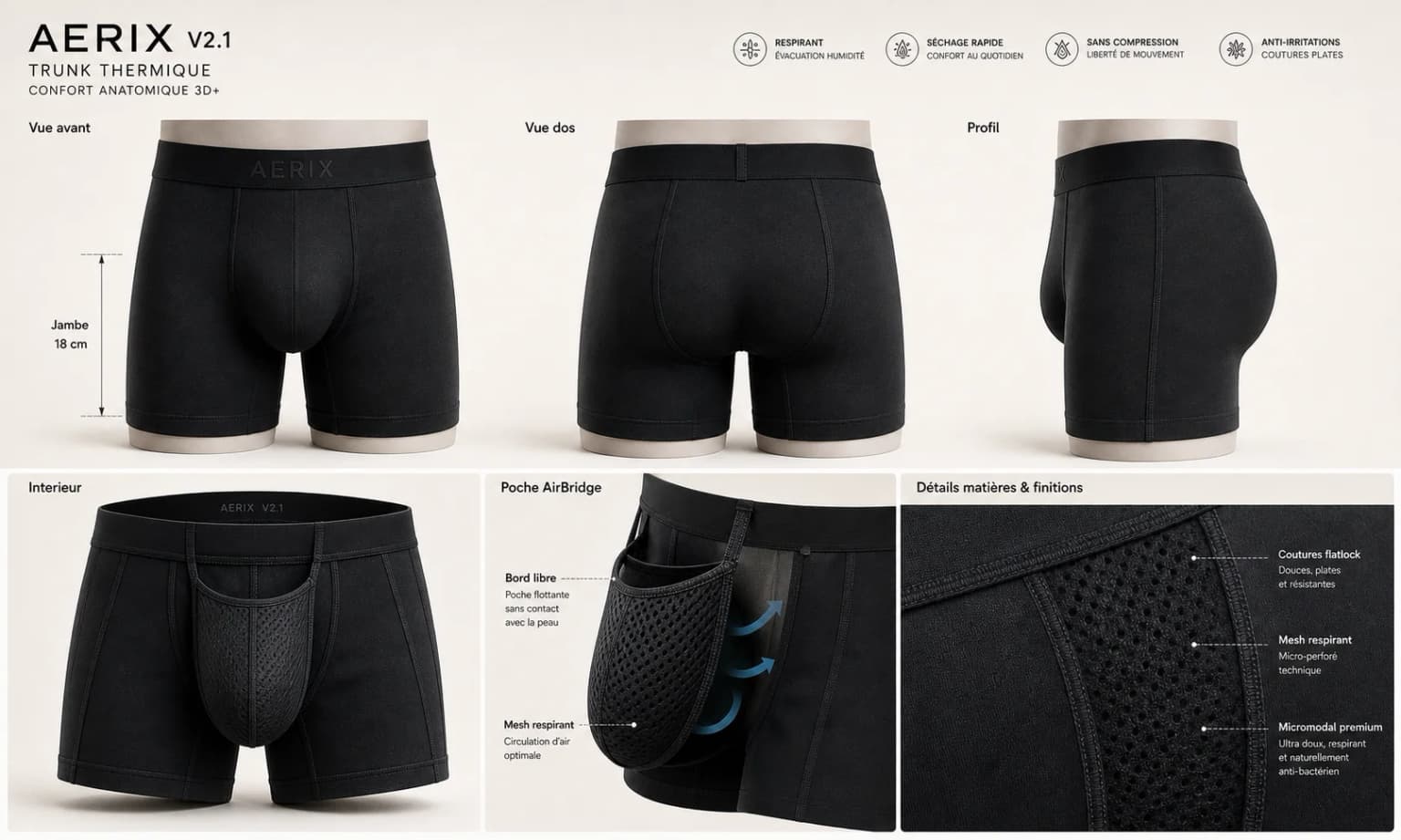
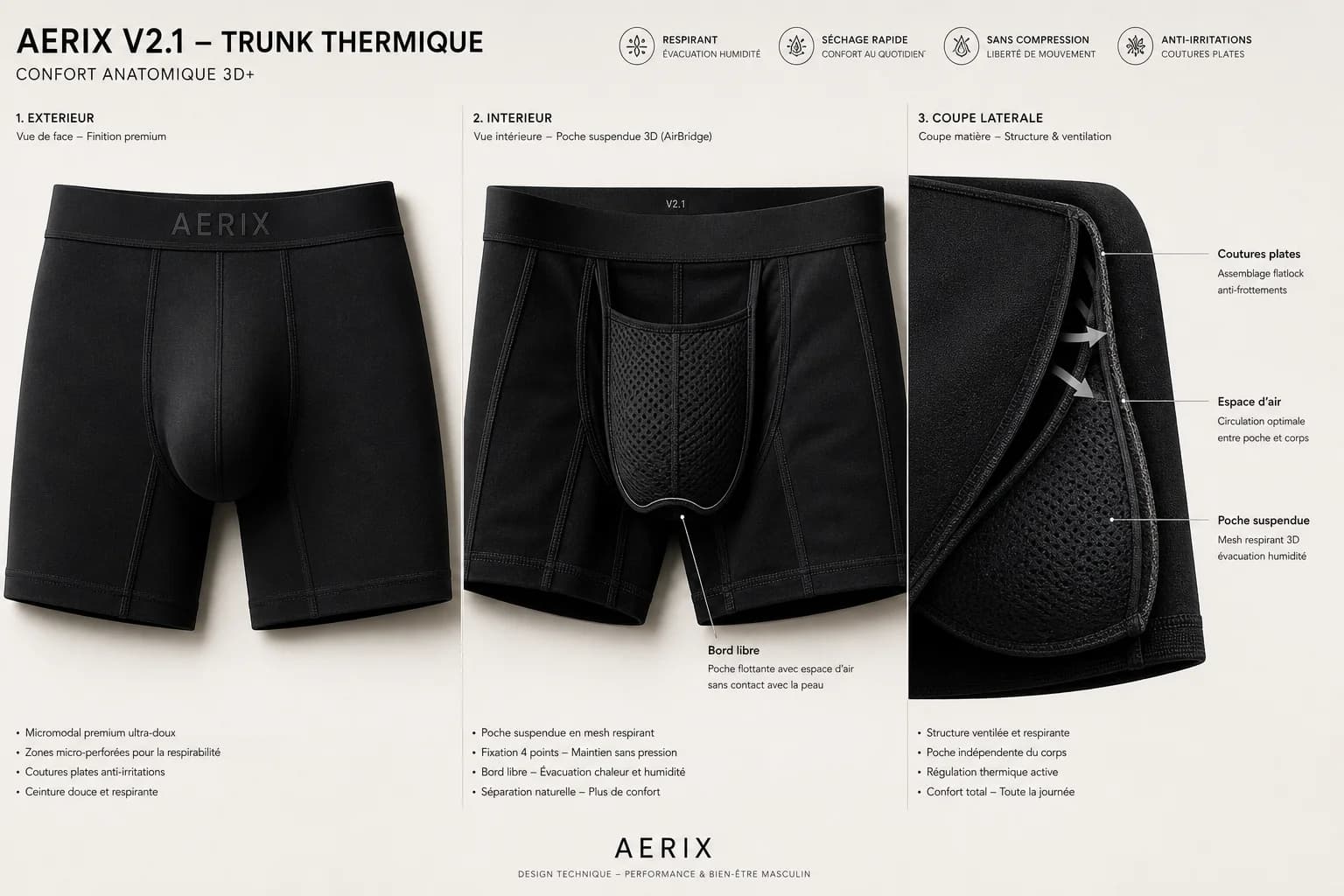
The engineering solution is a suspended pouch construction — specifically, a mesh sling attached at the top and sides with a free-floating bottom edge. This creates a literal air gap between the intimate area and the thigh contact zone. Even during sedentary sitting, passive convective currents can move air through this gap, providing a meaningful reduction in local temperature.
---
Cause 3: Tight Waistband — Restriction and Circulation
A waistband that's too tight restricts circulation in two ways: physically (direct pressure on the area) and thermally (pressure reduces the space available for airflow). A tight waistband also tends to roll or fold under during seated activity, creating a ridge that digs into the skin at the point where your hip flexors are most engaged.
In an office environment — where you're seated for extended periods and the waistband is under continuous pressure from your posture — a poorly designed waistband becomes disproportionately uncomfortable. The restriction effect compounds the heat effect: less circulation plus more heat retention equals faster discomfort escalation.
The solution is a wide, flat-knit anti-roll waistband sized accurately to your body — snug enough to stay in place, wide enough to distribute pressure, designed to stay flat under seated pressure.
---
The Combined Solution Architecture
The three causes above suggest three specific design requirements:
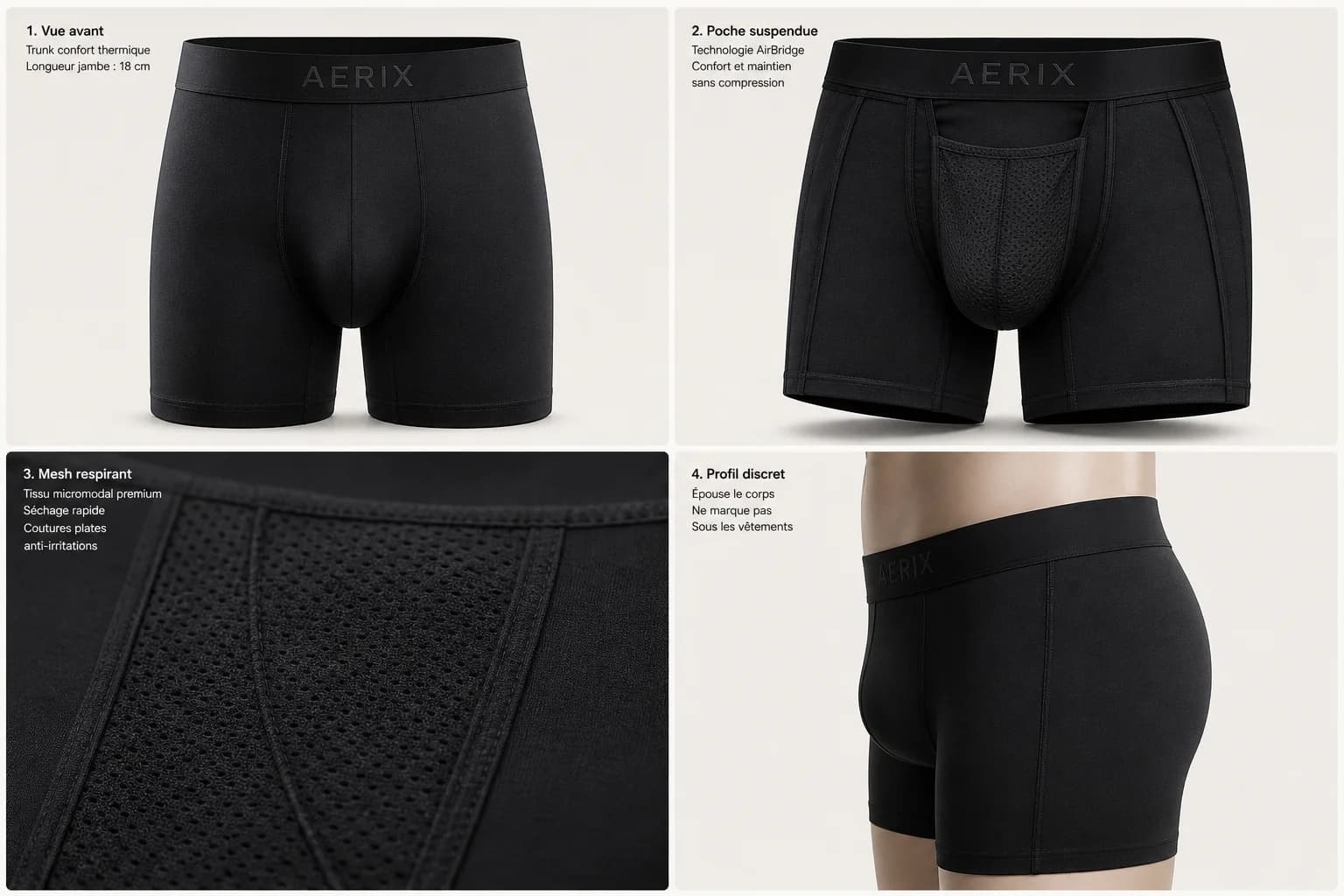
- Micromodal outer shell — handles moisture, stays dry, resists odor, feels cool
- Suspended mesh sling (AirBridge) — creates air gap, enables passive convective airflow even while sitting
- Anti-roll flat-knit waistband — stays in place, no restriction, no rolling
This is exactly the construction architecture behind AERIX. The HeatBreak diamond gusset provides additional mesh surface area for airflow at the base — where heat concentration is highest in the seated position. The result is underwear that works *with* your body's thermoregulatory system during a full workday rather than working against it.
For more on the science behind thermal comfort and its physiological implications, see our article on why thermal comfort matters.
---
Practical Steps You Can Take Today
Even without replacing your underwear, a few changes can reduce office overheating:
- Stand up every 60–90 minutes: Breaking up prolonged sitting allows the intimate area to recalibrate its temperature. Even 2–3 minutes standing or walking helps.
- Avoid synthetic fabrics in summer: If you have modal or micromodal underwear, wear those specifically on warm days or in warm offices.
- Check your waistband fit: If your waistband leaves a mark at the end of the day, it's too tight. The restriction is adding to your heat problem.
- Choose the right pants: Thick wool trousers over flat-seated chairs is the worst possible combination with inadequate underwear. Looser-fit trousers improve the situation even if the underwear doesn't change.
---
Conclusion
Office overheating is a real physiological phenomenon driven by sitting posture, wrong fabric, flat underwear construction, and waistband restriction — not by the ambient temperature. The fix is specific: micromodal fabric for moisture management, suspended mesh construction for airflow, and an anti-roll waistband for unrestricted circulation.
AERIX was designed to solve exactly this problem. Join the waitlist to be among the first to receive it.
No payment now. Just a priority alert, product behind-the-scenes and first availability.